Want to save with Paschal? Don’t miss our current offers and specials

Want to save with Paschal? Don’t miss our current offers and specials

Want to save with Paschal? Don’t miss our current offers and specials
Return to Paschal Resource & Education Hub
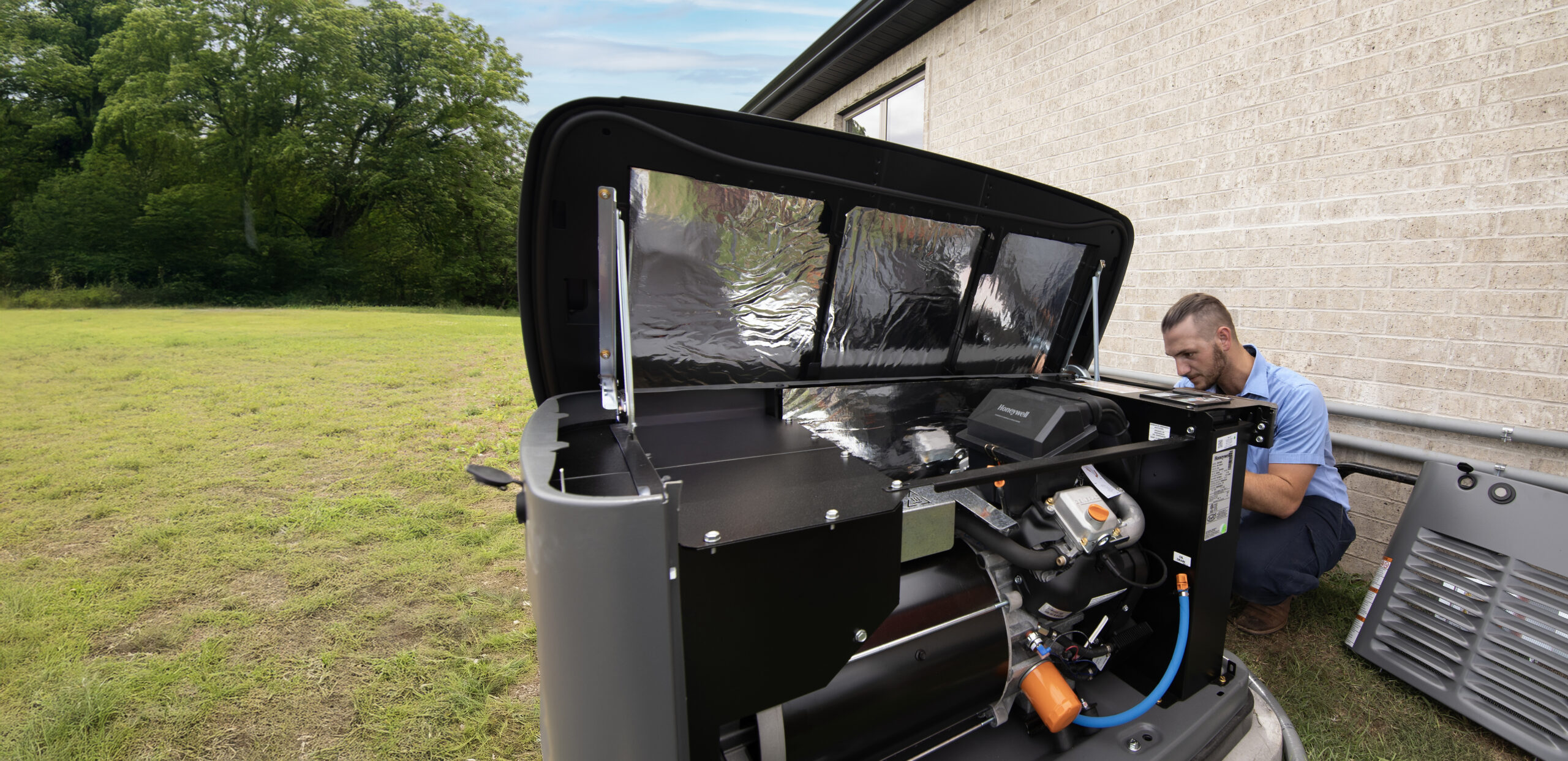
Most homes need a standby generator somewhere between about 14 and 26 kilowatts (kW) to run the whole house, while a smaller unit can cover just the essentials like the refrigerator, furnace fan, well pump, lights, and a few outlets. The right size for your home depends on what you want running during an outage, especially large loads like central air, an electric range, or an electric water heater. Here’s how generator sizing works, what drives the number up or down, and why a professional load calculation is the only way to get it exactly right.
Generator sizing isn’t really about the size of your house. It’s about your electrical load, meaning how much power the things you care about draw at the same time. Two homes of the same square footage can need very different generators depending on whether they have gas or electric appliances and how much of the home the owner wants powered.
There are two basic approaches.
A smaller generator powers a selected group of circuits: typically the refrigerator and freezer, furnace blower, sump or well pump, some lights, the garage door, internet equipment, and a few outlets. It keeps the house safe and livable, and it costs less up front.
A larger generator, often paired with load management, runs nearly everything in the house, including central air. Most homeowners who choose whole-home backup never have to think about what’s on or off during an outage.
A handful of appliances account for most of the load in a typical home. If you want these running during an outage, they’ll set the size of your generator.
If your home runs on natural gas or propane for heat, water heating, cooking, and drying, your generator can often be considerably smaller than it would be in an all-electric home.
Every motor-driven appliance, including air conditioners, refrigerators, and pumps, needs a brief burst of extra power to start. That startup draw can be two to three times the running load for a moment. A generator sized only for running watts may stall or trip when a big motor kicks on. This is the most common sizing mistake, and it’s the reason AC compressors are the deciding factor in so many homes.
Modern standby systems help manage this with load management modules and soft-start kits for air conditioners. These stagger or soften large loads so a generator can cover more of the home without jumping to a much bigger size.
These ranges are a starting point, not a quote. Your actual size comes from a load calculation.
Online calculators and square-footage charts give you a ballpark, but they can’t see your electrical panel. A professional sizing visit looks at your actual service size, the appliances on each circuit, whether they run on gas or electricity, your AC tonnage and startup load, and which circuits you want covered. That’s how you avoid two expensive outcomes: a generator too small to run what you need, or a bigger unit than you’ll ever use.
It also matters for fuel. Larger generators use more natural gas or propane, and your gas meter or propane tank has to be able to supply the generator at full load. A proper assessment checks that too.
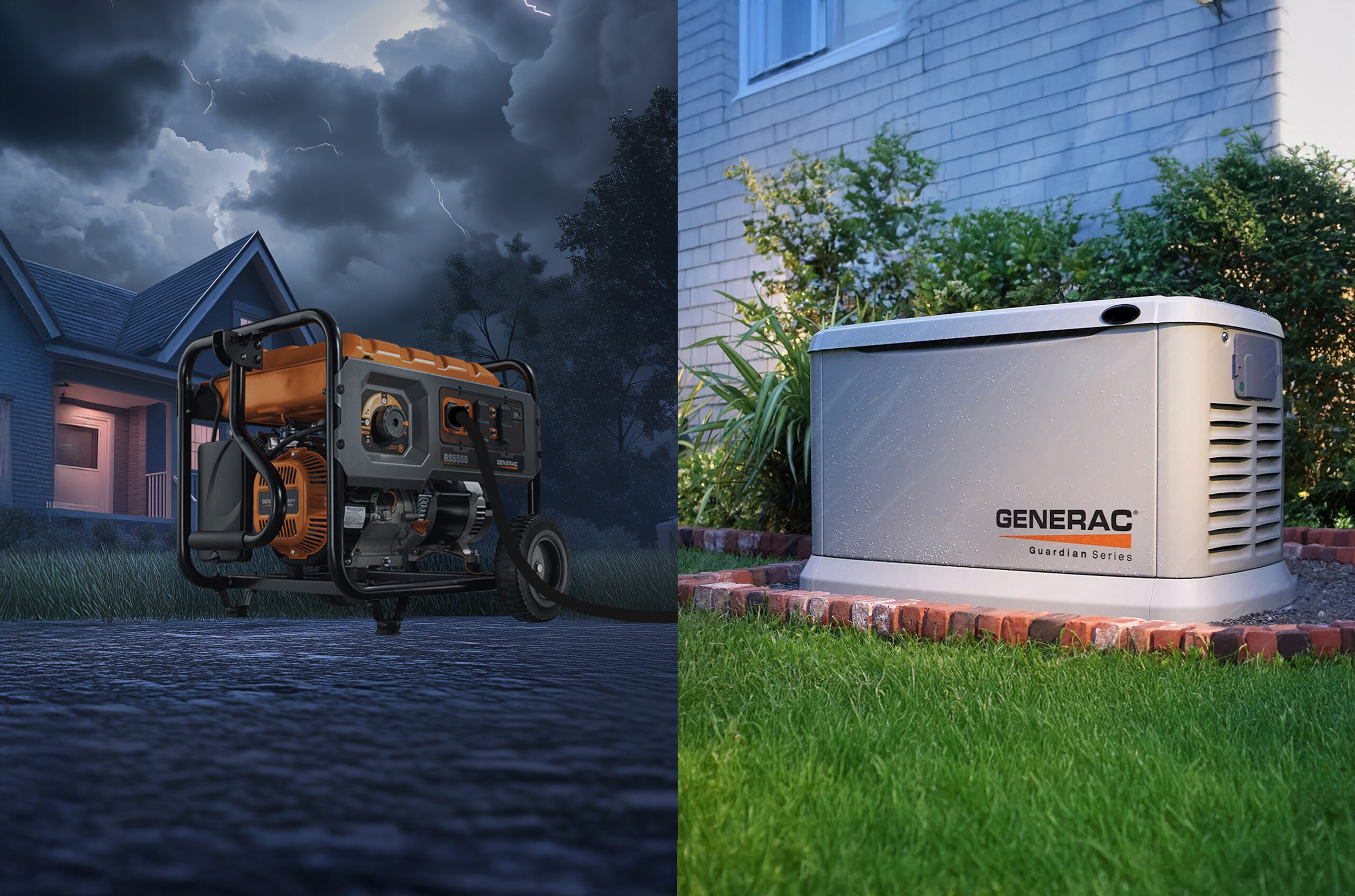
Portable generators are a budget option for running a few essentials through extension cords or a manual transfer switch. They need to be refueled, started by hand, and kept well away from the house because of carbon monoxide. A permanently installed standby generator starts automatically within seconds of an outage, runs on your home’s natural gas or propane, and powers circuits directly through an automatic transfer switch. For homeowners who want backup power that works while they’re away or asleep, standby is the better fit.
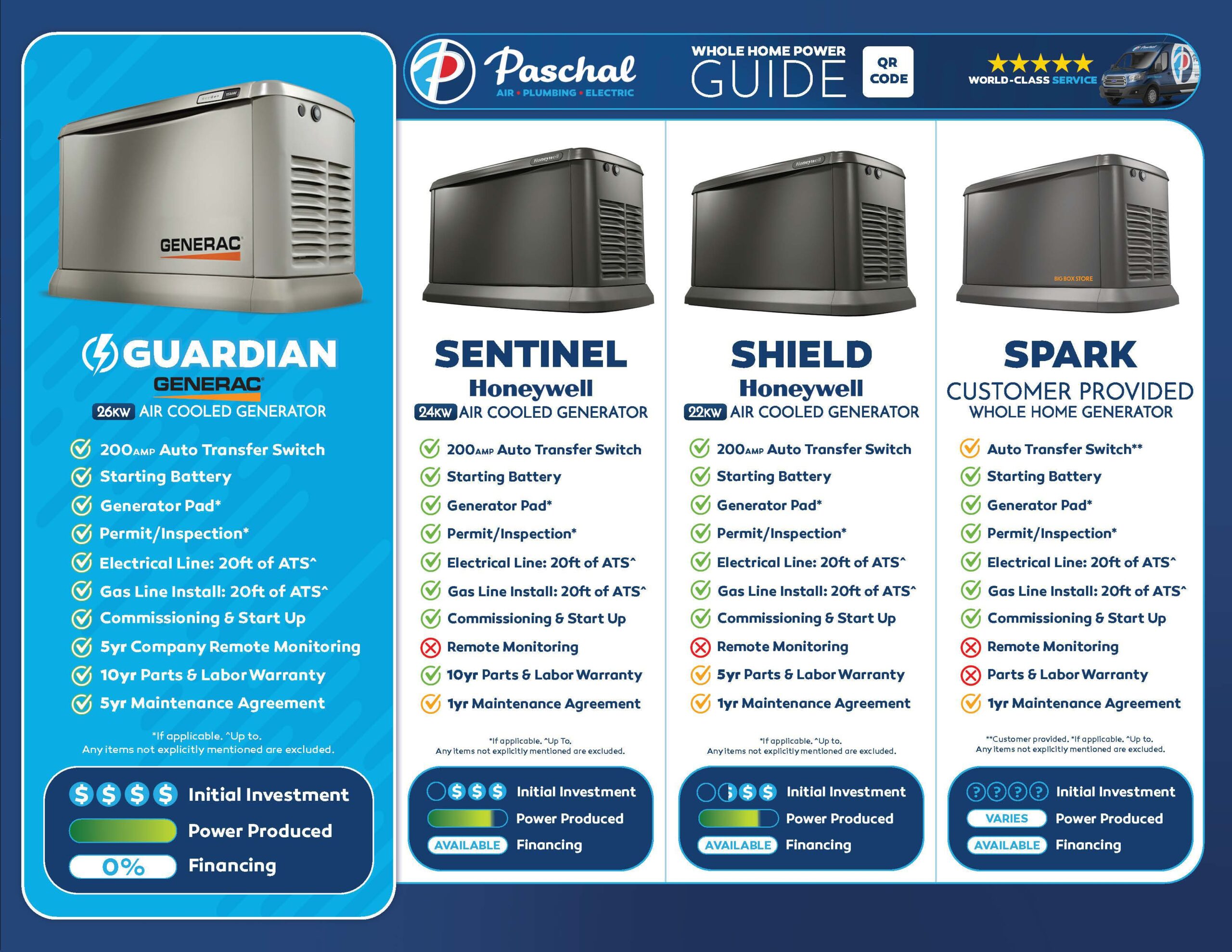
Paschal is an authorized Generac and Kohler dealer, and our licensed electricians size, install, and service standby generators from start to finish, including permits, the transfer switch, and the fuel connection. We’ll walk your home, run the load calculation, and show you exactly what each size option would cover. Learn more about generator installation, compare brands in our Generac vs. Kohler guide and whole-home generator comparison guide, or read what to do if a standby generator won’t start.
Many average-sized homes need roughly 16 to 22 kW for whole-home coverage, and larger or all-electric homes often need 24 kW or more. The biggest factor is central air conditioning. A load calculation gives you the exact number.
It depends on your AC’s size and its startup surge. Air conditioners draw much more power for a moment when the compressor starts, so the generator has to handle that peak. Soft-start kits and load management can reduce the size you need.
For many homes, yes, including one central AC system when load management is used. Larger homes, multiple AC systems, or all-electric homes may need more. The only way to know is a load calculation for your home.
Yes. An oversized generator costs more to buy, install, and fuel without adding real benefit. Sizing to your actual load, with a reasonable margin, is the goal.
Yes. A transfer switch safely connects the generator to your home’s circuits and prevents power from feeding back into utility lines, which can endanger line workers. Standby generators use an automatic transfer switch installed by a licensed electrician.

© 2026 Paschal Air, Plumbing & Electric. All rights Reserved. ARHVACR: 1448550 . ARPlumb: MP6860 . ARElec: M-11071 . ARContractor: 031664 . TXHVACR: TACLA129951E . TXPlumb: M-44920 . TXElec: TECL38435 . OKHVACR: 068145 . OKPlumb: 082277 . OKElec: 00227101 . Texas Department of Licensing and Regulations, PO Box 12157, Austin TX 78711 (512) 463-6599 . The Texas State Board of Plumbing Examiners, PO Box 4200, Austin TX 78765 (512) 936-5200 . Plumbing: #M-44920 RMP Joshua Gross