Want to save with Paschal? Don’t miss our current offers and specials

Want to save with Paschal? Don’t miss our current offers and specials

Want to save with Paschal? Don’t miss our current offers and specials
Return to Paschal Resource & Education Hub

A heat pump heats your home by moving heat instead of making it. Even when it’s cold outside, the outdoor air still holds heat energy. A heat pump uses refrigerant to absorb that heat outdoors, concentrate it with a compressor, and release it inside your home. In summer, it runs the same process in reverse and works as an air conditioner. Because it moves heat rather than burning fuel to create it, a heat pump can deliver more heat energy than the electricity it uses. Here’s how it works, step by step, in plain English.
A furnace creates heat by burning natural gas or propane, or by running electric heating elements. A heat pump works more like your refrigerator. Your fridge pulls heat out of the inside compartment and dumps it into your kitchen, which is why the back of it feels warm. A heat pump does the same thing on a larger scale, pulling heat from the outdoor air and moving it into your house.
That’s the key to why heat pumps are so efficient. Moving heat takes much less energy than generating it from scratch.
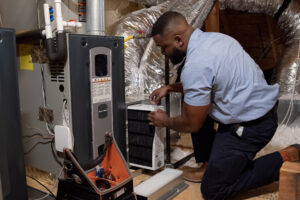
A heat pump has a part called a reversing valve that changes the direction the refrigerant flows. In cooling mode, the indoor coil absorbs heat from your home and the outdoor unit releases it outside, exactly like a central air conditioner. One system handles both seasons, which is why heat pumps are so popular across Arkansas, Oklahoma, Missouri, and Texas.
Because a heat pump moves existing heat instead of generating it by burning fuel, it can deliver two to three times more heat energy than the electricity it consumes in moderate weather. Electric resistance heat, like baseboard heaters or heat strips, converts electricity into heat one-for-one. That difference is why a heat pump can lower heating costs compared with all-electric resistance heat.
Heating efficiency is rated by HSPF2, and cooling efficiency by SEER2. Higher numbers mean more heating or cooling for each unit of electricity.
As outdoor temperatures drop, there’s less heat in the air to capture, so a heat pump has to work harder and its output falls. Most systems handle this in two ways.
On the coldest days, electric heat strips inside the air handler kick in to help. That’s what it means when your thermostat shows “AUX heat.” It’s normal in cold weather, but if it’s running constantly on a mild day, something may be wrong. Read more about what AUX heat on your thermostat means and how heat strips work.
Some homes pair a heat pump with a gas furnace. The heat pump handles most of the season, and the furnace takes over when it gets very cold. Learn how dual-fuel heat pumps work.
Today’s cold-climate heat pumps keep working efficiently at much lower temperatures than older models. For more on winter performance, see how cold weather affects heat pumps.
In cold, damp weather, frost can build up on the outdoor coil. To clear it, the heat pump briefly runs a defrost cycle, switching into cooling mode for a few minutes to warm the outdoor coil. You may see steam rising from the unit and hear a whoosh when it switches back. That’s normal. A unit that stays coated in thick ice for hours is not, and it needs service.
All heat pumps work on the same principle of moving heat, but they pull that heat from different sources.
The most common type in homes. An air-source heat pump extracts heat from the outside air in winter and transfers heat from your home to the outside air in summer. It connects to your ductwork through an indoor air handler, just like a central air conditioner. For most homes, this is the heat pump people mean when they say “heat pump.”
A ductless system pairs an outdoor unit with one or more wall-mounted indoor units, with no ductwork required. Mini-splits are a great fit for additions, garages, sunrooms, and older homes without ducts, and each indoor unit controls its own zone.
A geothermal heat pump extracts heat from the ground instead of the air. A few feet below the surface, the ground stays at a fairly steady temperature year-round, so a ground-source system doesn’t lose performance on freezing days the way an air-source unit can. Water circulates through buried loops to absorb heat in winter and release it in summer. Geothermal systems cost more to install but are among the most efficient heating and cooling technology available. Learn more about geothermal heating.
Less common in homes, a water-source heat pump uses a well, pond, or water loop as its heat source. You’ll see these more often in commercial buildings.
The same technology can heat water. A heat pump water heater pulls heat from the surrounding air to warm the water in its tank, using far less electricity than a standard electric water heater. Here’s how a heat pump water heater compares with a conventional one.
Heat pump efficiency is often described by its coefficient of performance, or COP. A COP of 3 means the heat pump delivers three units of heat energy for every one unit of electricity it uses. Electric resistance heat has a COP of 1. That’s where the energy savings come from: the electricity runs the compressor and fans, while the heat itself comes from outside, essentially for free.
COP changes with the weather. On a mild fall day, a heat pump can run at very high efficiency. As outdoor temperatures drop toward freezing and below, there’s less heat to extract, the compressor works harder, and efficiency falls, although a modern heat pump still generally outperforms electric resistance heat.
Variable-speed, or inverter, heat pumps take efficiency further. Instead of switching fully on and off, the compressor ramps its speed up and down to match the load, which reduces energy use, keeps temperatures steadier, and improves comfort.
With regular maintenance, most air-source heat pumps last roughly 10 to 15 years. Because they run in both heating and cooling mode, they accumulate operating hours faster than an air conditioner that only runs in summer. Geothermal ground loops can last decades, while the indoor heat pump unit typically lasts about 20 years. Annual service, clean filters, and a clear outdoor unit are the biggest factors in reaching the upper end of those ranges.
A heat pump that’s too small will lean on backup heat all winter and struggle in summer. One that’s too large will short cycle, waste energy, and leave the home clammy in cooling mode. The right size comes from a load calculation that accounts for your home’s insulation, windows, ductwork, and local climate, not just its square footage.
A heat pump is a strong choice if you want one system for heating and cooling, if your home doesn’t have natural gas, or if you want to cut your reliance on fossil fuels. A furnace, or a dual-fuel setup, may make sense if you have natural gas available and see long stretches of very cold weather. The right answer depends on your home, your fuel options, and how you use your system, and it starts with a proper load calculation.
| Feature | Heat pump | Gas furnace |
|---|---|---|
| How it heats | Moves heat from outside air or the ground | Burns natural gas or propane |
| Cooling | Yes, the same system cools | No, needs a separate air conditioner |
| Fuel | Electricity | Natural gas or propane |
| Supply air temperature | Warm, steady | Hotter, in shorter bursts |
| Performance in extreme cold | Drops, uses backup heat | Unaffected by outdoor temperature |
| Combustion in the home | None | Yes, requires venting and CO safety |
A few habits make a big difference in comfort and energy use during heating season.
A professional heat pump tune-up before winter typically includes checking the refrigerant charge, testing the reversing valve and defrost controls, inspecting electrical connections and the capacitor, cleaning the indoor and outdoor coils, checking the auxiliary heat strips, measuring airflow, and confirming the thermostat is controlling the system correctly. Catching small problems in the fall is far better than discovering them on the first freezing night. Schedule heating maintenance to get your system ready for the season.
Because a heat pump works year-round, it racks up roughly twice the running hours of an air conditioner. That makes regular maintenance even more important. Change your filter on schedule, keep the outdoor unit clear of leaves and snow, and schedule a tune-up before heating season. Paschal’s Planned Protection Membership includes up to two system checks a year. For heating service, repair, or a new system, explore our heating services or schedule heating repair online.
A heat pump absorbs heat from the outdoor air, even when it’s cold, using refrigerant. The compressor concentrates that heat, and the indoor coil releases it into your home. On very cold days, auxiliary heat strips or a gas furnace can help.
Yes. Output drops as temperatures fall, but modern heat pumps keep heating well into freezing temperatures, and cold-climate models work at much lower temperatures. Backup heat covers the coldest days.
Compared with electric resistance heat, a heat pump is usually much cheaper to run because it moves heat instead of generating it. Compared with a gas furnace, it depends on local electricity and gas rates and your climate.
That’s usually the defrost cycle. The heat pump briefly reverses to melt frost off the outdoor coil, which can produce steam. It’s normal. Thick ice that doesn’t clear needs service.
Yes. A reversing valve changes the direction refrigerant flows, so the same system heats in winter and cools in summer.
A heat pump doesn’t suddenly stop, but its heating output and efficiency drop as the temperature falls. Many standard models start relying more on backup heat somewhere below freezing, while cold-climate models keep heating efficiently at much lower temperatures.
Air-source heat pumps lose performance in extreme cold and may need backup heat, the supply air feels cooler than a gas furnace’s, and the system runs year-round, so it accumulates more wear. Geothermal systems also have a higher upfront cost.
Most air-source heat pumps last about 10 to 15 years with regular maintenance. Geothermal indoor units often last around 20 years, and their ground loops can last decades.


© 2026 Paschal Air, Plumbing & Electric. All rights Reserved. ARHVACR: 1448550 . ARPlumb: MP6860 . ARElec: M-11071 . ARContractor: 031664 . TXHVACR: TACLA129951E . TXPlumb: M-44920 . TXElec: TECL38435 . OKHVACR: 068145 . OKPlumb: 082277 . OKElec: 00227101 . Texas Department of Licensing and Regulations, PO Box 12157, Austin TX 78711 (512) 463-6599 . The Texas State Board of Plumbing Examiners, PO Box 4200, Austin TX 78765 (512) 936-5200 . Plumbing: #M-44920 RMP Joshua Gross